Sunday, February 06, 2011
Therapist Works to Green his Practice
Tim Desmond, a therapist in private practice in Oakland, CA, has signed up for our Greener Businesses program. He is moving toward a 100% phone counseling practice, which he estimates could save thousands of miles of driving each year for him and his clients. He recently posted about his experiences moving from in-person to phone counseling on our main blog. You can read more about him as well as case examples of his work on his website www.coherencecounseling.com


Tuesday, January 04, 2011
Fountain Spirit Moving Toward Greener Vistas!
Fountain Spirit is moving toward an environmentally sustainable business model. By sourcing components from companies that have environmentally sound manufacturing methods, running a virtually paperless office, and adding a line of Solar Fountains they will make great strides toward becoming a green company. Solar Fountains are a big step toward this as the water circulates with no electricity!
Visit Fountain Spirit (www.fountainspirit.com) to find beautifully crafted fountains that will suite any aspect of your home. Add a conversation piece to your coffee table with one of their Table Top Fountains or accent your gardens natural beauty with an Outdoor Fountain. If you’re redecorating consider a larger indoor Floor Fountain and enjoy the relaxing sound of water flowing whenever you wish.
Visit Fountain Spirit (www.fountainspirit.com) to find beautifully crafted fountains that will suite any aspect of your home. Add a conversation piece to your coffee table with one of their Table Top Fountains or accent your gardens natural beauty with an Outdoor Fountain. If you’re redecorating consider a larger indoor Floor Fountain and enjoy the relaxing sound of water flowing whenever you wish.
Title - Fertilizing Lawns with Coffee Grounds
How to Fertilize Your Lawn with Coffee Grounds
If you have ever used fertilizer on your lawn, this article is going to be of interest to you.
There is an almost limitless supply of spent coffee grounds, from cafes and offices all around the country, and they are great for established lawns.
Using coffee grounds for your lawn also means you'll save a few dollars by not buying all that commercial fertilizer, most of which is labour intensive at every step from manufacture to your door. In a previous article titled How a Cafe turns coffee grounds to fertilizer, I highlighted why using the grounds directly from a cafe is the most environmentally friendly way to go.
The reason why coffee grounds are suitable as a fertilizer is because they are high in nitrogen, which is the same nutrient that is lost in the greatest quantity when lawn is mowed. The best period to apply fertilizer to lawns is when you see it starting to grow, because that is when it will make the most of what you put down.
Coffee grounds can also be used to build up the soil on which lawn or other plants are growing, and they can be used in up to 25% of a new garden bed, provided they are mixed in well with the remaining 75% of soil.
Selecting the Correct Grind for the Lawn
When you start collecting coffee grounds, you will notice that they come in different grind types. More often than not the coffee grounds coming from a cafe will have a fine grind, and the automated espresso machines tend to be a medium grind.
While the automated machine will give you the same grind every time, with cafes there is no fixed rule to this. I've seen some cafes that use a medium grind, and some grounds as fine as talcum powder. What seems to work best for the lawn is towards the medium side, because it is easier to spread and takes longer to break down once in the soil.
Steps to Fertilize the Lawn
1. Pour the coffee grounds onto an area of lawn you want to fertilize. Avoid doing this right after rain as the ground will be soggy and raking them in evenly is going to be difficult. Some folks prefer to take grounds by the handful and scatter them directly and that way is just fine, although this will take you longer, and will not be as evenly spread as the method below.

2. Break up the coffee grounds with a shovel or trowel, enough so that the large chunks are gone. It will cause you problems if those little coffee lumps are sitting on your lawn like mud pats, and it will take longer for them to breakdown than you want them to.
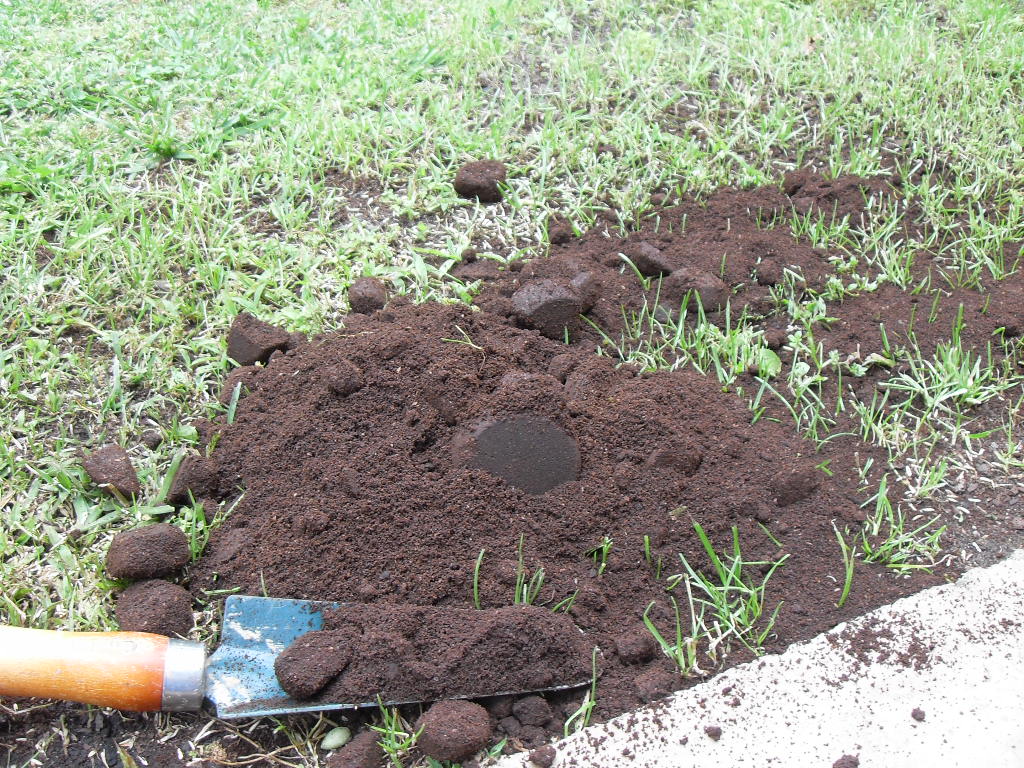
3. A wide head plastic rake will do the trick for spreading grounds, and a light metal one is also OK. Try to avoid a heavy rake as this will damage your lawn and not necessarily be any good at spreading the grounds around.
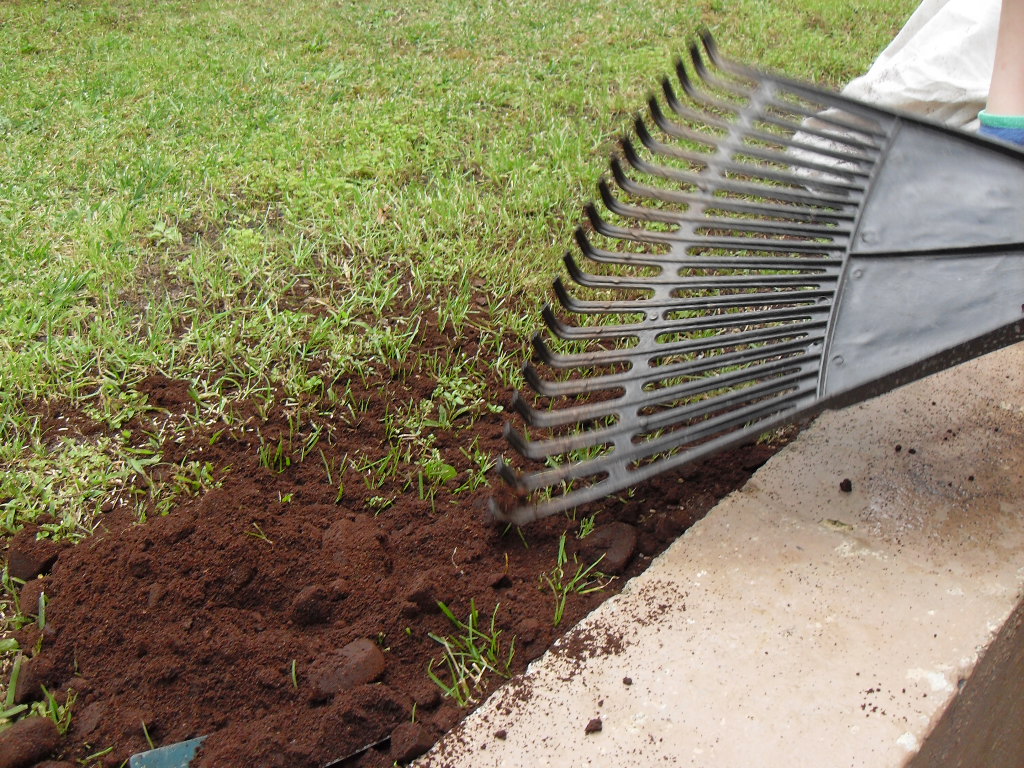
4. Start spreading the coffee grounds around the lawn in nice long even strokes.
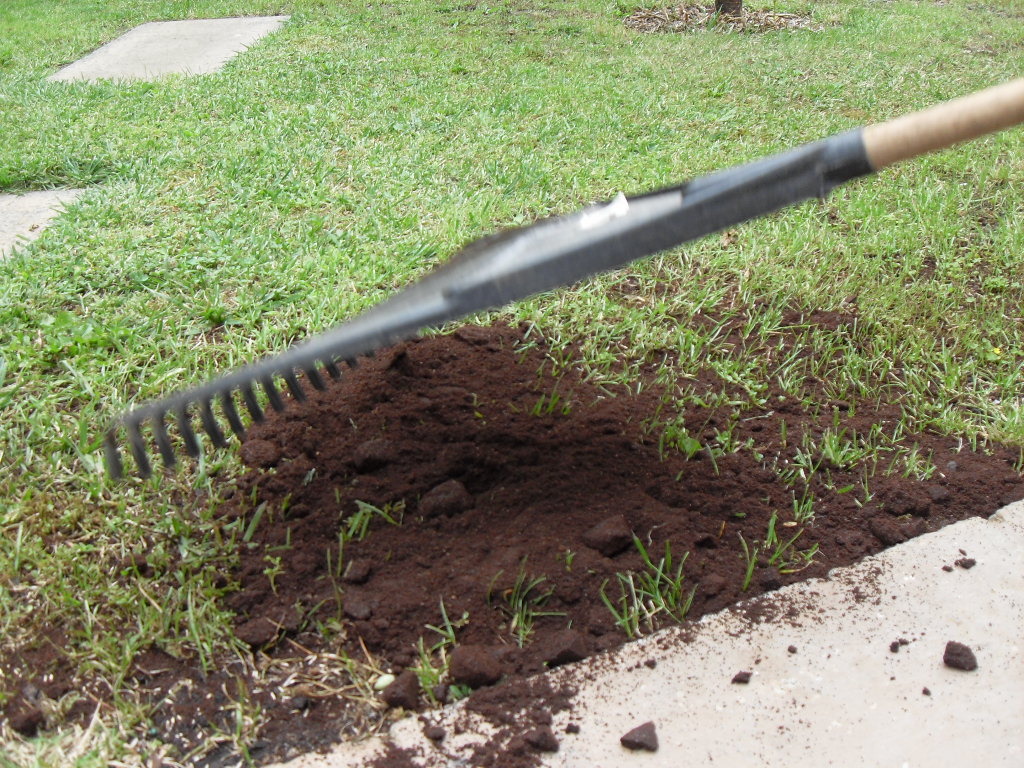
5. The grounds will disappear into the soil before too long. It is best to blend them over an area so that the lawn is only one quarter covered with grounds. Any more than that and it might cause problems with air and water movement through to the grass roots.

6. Now blended in nicely.
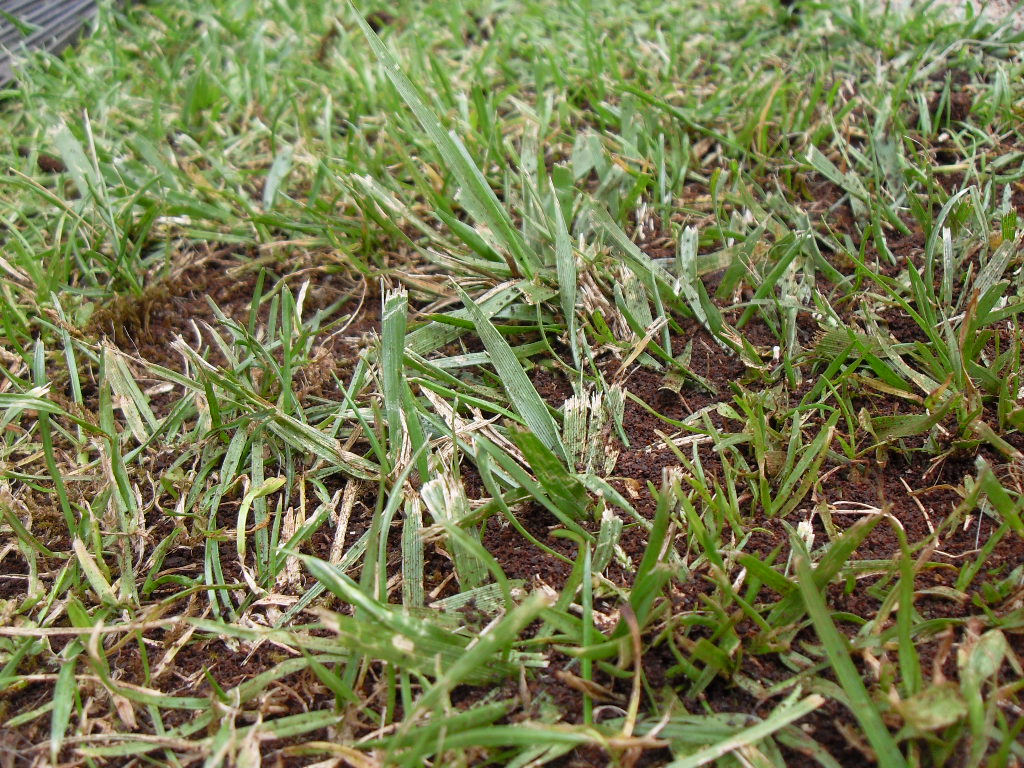
7. The final step is to water in the grounds, a good soak through will stop them from coming loose, giving them every chance to return to the soil.

Spent coffee grounds for fertilizing your lawn is an effective and low cost solution which also makes a contribution to the environment. Using the grounds saves them from going to landfill, and you will have less of a need for those commercially manufactured products.
Just reapply every 8-10 weeks during the lawn growth period, and you will be rewarded in many ways.
To learn more about using coffee grounds in the garden, stop by the Ground to Ground site, fast become this subject's most comprehensive body of knowledge.
Monday, January 03, 2011
5 tips for eco friendly offices

- Switch to Laptops: Laptops computers use only 10% of the energy required by desktops, and take up less desk space, opening up the possibility of a smaller office. Even better, buy used laptops. Check out our main blog for a guide to buying a used laptop. You can often get great deals on business ready models.
- Avoid the photocopiers: Photocopiers are energy hogs. Use them sparingly, and remember to shut them off at night. Amazingly, A photocopier not turned off overnight and left in standby uses enough energy to produce over 1,500 photocopies.
- Switch to LED Lighting: Led lighting can reduce carbon footprint by 70%, and more than pays itself back over time. No-brainier, right? Yet more than 70% of commercial installations have not yet switched over.
- Telecommute one day a week: Most people telecommute alone in a car, which, of course, is a huge amount of energy. Also, many people find they are more productive working from home once a week, and look forward to making productive use of the commuting time they save. Encouraging employees to telecommute one day a week will cut your transportation budget by 20% and often leads to happier employees.
- Turn down the Heat/AC: Every degree colder in the winter (or hotter in the summer) that you can tolerate over an 8 hour period will lead to a one percent drop in your fuel bills. Try one degree at a time during the day, and turn it down a significant ammonium at night.
Monday, December 13, 2010
Folding Electric Bikes
Change the way you commute with a folding electric bike! Take your folding electric bike on public transportation and continue right to work! Check out all types of folding electric bikes at foldingelectricbike.org.
Hempwallet.org
Check out hempwallet.org to find eco conscious wallets for all your friends this holiday season! Hemp is a durable fabric that requires much less pesticide and other chemicals than more traditional crops such as cotton. Visit hempwallet.com today!
Friday, November 19, 2010
What does an eco business look like?
Lots of people think that running an eco business means that you have to do something overtly green... grow organic vegetables, make solar panels, etc.
While these are doubtless great things to do, they are not the only option.
As an example, our friend Lily Hart over at Dancing Rabbit Ecovillage does a job few would think to associate with eco living. She teaches latin over the internet.
However, her latin tutoring business manages to have a deep green foundation.
In the comments, let us know what ideas you might have for how a business not normally associated with eco living could become more green!
While these are doubtless great things to do, they are not the only option.
As an example, our friend Lily Hart over at Dancing Rabbit Ecovillage does a job few would think to associate with eco living. She teaches latin over the internet.
However, her latin tutoring business manages to have a deep green foundation.
- She telecomutes, so no cars or subways in her day-to-day carbon footprint
- She works from an energy efficient natural strawbale cabin, heated with sustainably harvested wood
- She powers her business entirely with renewable solar pannels
- She buys used books when possible, and runs a nearly paperless office
In the comments, let us know what ideas you might have for how a business not normally associated with eco living could become more green!
Tuesday, November 16, 2010
Organic Grade B Maple Syrup
Try some Organic Grade B Maple Syrup on your pancakes or waffles! Organic Grade B Maple Syrup is most commonly used for cooking but it's slightly stronger flavor also lends itself to replacing more traditional syrups. Buy organic and contribute to sustainable farming practice and ensure that your purchases leave the earth green.

Greenmarketing.tv - Social Enterprise & Green Marketing
If you own a business that you want to take green or if you are interested in starting a company that has an eco conscious focus or message of social change visit this green marketing blog. Greenmarketing.tv is an informative resource that provides entrepreneurs with the tools necessary to create a thriving green business both online and offline. Visit Greenmarketing.tv to learn more.
Thursday, May 20, 2010
Salomon Shoes & Boots
Check out the Salomon Kreation Alpine Ski Boots for your next skiing journey. For trail running try the Salomon XA Pro 3D Ultra GTX Trail Running Shoes. For running shoes try Salomon XT Wings Trail Running Shoes. For something breathable try the Salomon Exit Aero Shoes. For something a little different check out the Full Tilt Classic Alpine Ski Boots.
AppOutdoors Hiking Gear
Keep yourself hydrated on the trails with the Camelbak .75 Liter Insulated Bottle Carrier. For something a little different try the Camelbak 100 oz Omega Reservoir. Find yourself the perfect tent at AppOutdoors. Shade your eyes on the trails with some Oakley Sunglasses! If you take your dog on the trails with you look at our selection of dog gear and dog toys.
The North Face at AppOutdoors
AppOutdoors has a huge selection of The North Face clothing and gear. Hit the trails with the North Face Big Shot Backpack from AppOutdoors. If you need a winter jacket grab this classic North Face Nuptse Jacket. If you plan on exercising in the cold try the North Face Animagi Jacket. For a versatile winter jacket check out the North Face Valkyrie Jacket.
AppOutdoors climbing, skiing, and hiking gear.
For climbing check out this Sterling 7/16'' Superstatic Rope from AppOutdoors. When you're on the slopes jam out with this Bern Black Audio Knit Liner. For your next backpacking trip take the Gregory Mountain Denali Pro Backpack along with you. Work on your climbing chops with the Metolius 3D Simulator Climbing Training Board.
Keen Sandals at AppOutdoors
Check out the Keen Waimea Leather Sandal at Appoutdoors. For something to get around town in try these Keen Austin Shoes. Slide in the Keen Venice H2 womens sandals for a closed toe sandal that will protect your feet on the trails and in water. For a rugged all-purpose womens shoe try the Keen Genoa Peak WP.
AppOutdoors Athletic Footwear
AppOutdoors is the place for rugged footwear, check out the Chaco z/1 Unaweep sandal for a tough all purpose sandal. For an all-purpose trail shoe try the Salomon XA Pro 3D Ultra GTX shoe. For tough running shoes look into the Salomon XT Wings Running Shoes. Try these Smartwool Socks as the perfect counterpart to your athletic shoes!
Patagonia at Appoutdoors
Carry about your worldly possessions with one of these Patagonia Lightweight Travel Slingbags from AppOutdoors. Go on a road trip in style with the Patagonia Trucker hat. Try the Patagonia Margot Dress on a summer day and feel the breeze!
Take a look at this variety of AppOutdoors specials and brands. If you're looking for footwear take a minute and browse Appoutdoors footwear. You can find nearly any type of footwear here, take a look at AppOutdoors shoes selection now. If you need a jacket for the fall look at these womens jackets from Appoutdoors!
Life Is Good at AppOutdoors
AppOutdoors has a huge selection of cool Life Is Good clothing items. We know you're always on the lookout for a great deal so check out this Life Is Good clothing specials page and save! Add some style to your jeep or SUV with a Life Is Good Tire Cover. Add this Life Is Good Tis the Season Crusher tee to your childs wardrobe. Or if lacrosse is the popular sport in your home check out the Life Is Good Lacrosse Jake Crusher tee.
Santiki Clothing at Appoutdoors!
Check out Santiki Clothing at Appoutdoors! The Santiki Ravea dress is perfect for relaxing on a summer day. Or check out the Santiki Destiny dress for an elegant strapless look. For an earthier vibe try the Santiki Trixie dress this summer!
Vibram Fivefingers Barefoot Shoes
Check out AppOutdoors selection of Vibram Fivefingers barefoot running shoes. If you need all purpose barefoot running shoes grab the Vibram Fivefingers KSO Barefoot Shoes. For a more minimalist design look at the Vibram Fivefingers Classic Barefoot Shoes. If you want a versatile barefoot shoe that lets your feet breathe slip on the Vibram Fivefingers Sprint barefoot running shoes. If you need a more rugged shoe consider the Vibram Fivefingers KSO Trek barefoot running shoes. For the original barefoot running experience slide on the Vibram Fivefingers Classic barefoot running shoes!
Thursday, March 04, 2010
Motion Activated Solar Path Light
Use the power of the sun to light your way through your yard or garden. This Motion Activated Solar Path Light can save you money over time and needs no electricity to keep your home looking beautiful and safe.

Eco Baby Stroller
You'd be surprised at how few options exist for eco baby stroller. We've got 'em all! Take a look here at some option for eco strollers that are made from recycled and recyclable materials.

Children's Chair & Ottoman
Take a look at this cute eco friendly Children's Chair & Ottoman! Your kid needs to put their feet up too...right?

Water Saving Faucets
Water Saving Faucets are an easy, small investment that will save you money and save one of our most precious resources. When it comes time to replace your current faucets make the eco choice and purchase water saving faucets!

Certified Organic Chia
Certified Organic Chia is a filling, tasty, and healthy treat for snacking on throughout the day. Try some organic chia today!

Organic Baking
Baking is a fun, satisfying, and productive activity. Do some organic baking and give some organic goodies to your friends, family, and co-workers!

Natural Cribs
If you've got a new child on the way consider a natural baby crib or a sustainable baby crib. These cribs are made from sustainable woods and/or recycled components. Make a healthy choice for your child and keep the earth green with a natural baby crib.

Organic Kids Clothing | Organic Kids Clothes
Organic clothing isn't just for adults. Remember that children are often the most sensitive to toxins in fabrics that are found in traditional cotton. Consider buying some organic kids clothing and make a healthy and environmentally friendly choice.

Organic Baby Clothes
Slip your young one into some organic baby clothes! Organic baby clothing is soft, soothing, and an excellent choice when the environment is concerned.

Organic Pistachio Nuts
Organic Pistachio Nuts are a tasty addition to many baked goods! Grab some organic pistachio nuts and treat yourself to only the very best!

Subscribe to:
Posts (Atom)